Portfolio
PAGANISM
I'm a title. Click here to add your own text and edit me.
I'm a title. Click here to add your own text and edit me.
PAGANISM
Client
Client
Medical Expo
Medical Expo
I'm a paragraph. Click here to add your own text and edit me. It’s easy. Just click “Edit Text” or double click me to add your own content and make changes to the font. I’m a great place for you to tell a story and let your users know a little more about you.
I'm a paragraph. Click here to add your own text and edit me. It’s easy. Just click “Edit Text” or double click me to add your own content and make changes to the font. I’m a great place for you to tell a story and let your users know a little more about you.
Client
Medical Expo
I'm a title. Click here to add your own text and edit me.
I'm a paragraph. Click here to add your own text and edit me. It’s easy. Just click “Edit Text” or double click me to add your own content and make changes to the font. I’m a great place for you to tell a story and let your users know a little more about you.


Streamliner
Designing a 5x Faster Worldwide Post-Sale Framework for a Global Tech Leader
The Context
Our Client operated credit, return, and exchange processes differently across regions—driven by local policies, systems, and workflows.
This fragmentation resulted in inconsistent customer experiences, operational inefficiencies, and high dependency on manual approvals.

Our Approach
Our mission was to design a unified, scalable post-sale framework that simplifies complexity while supporting regional realities.

Understanding the Landscape
We conducted deep-dive interviews with users and stakeholders across 17 countries. This included regional customer support teams, operations, and key business stakeholders.
Through these sessions, we mapped local nuances, constraints, and customer expectations in credit, return, and exchange processes.
17
Countries Covered
60+
User Interviews
54+
System Artifacts
3
Tools Audited
Mapping
of As-is
System
We visualized the current state in three ways: customer journey maps to highlight user pain points, process maps to capture end-to-end operational flow, and service blueprints to show how systems, teams, and touchpoints interact behind the scenes. This holistic mapping exposed both customer-facing friction and internal inefficiencies.
As-Is Customer Journey Map
Discover & Empathize

The captured user journey was brought to life with an interactive layer powered by Claude AI. All insights and data were integrated, turning it from a simple 2D map into a dynamic, interactive design artifact.
As-Is Process Map
Analyze & Diagnose

As-Is Service Blueprint
Align Experience & Operations

Translating Findings into Insights
From this comprehensive view, we identified global patterns. While each region had unique variations, common challenges emerged—such as fragmented systems and inconsistent workflows. These insights laid the groundwork for a globally streamlined, yet locally adaptable, future-state solution.
Carrier
Integration
-
1 of 7 regions has automated carrier integration
-
6 of 7 regions rely on manual portals or email
-
High agent effort and dependency for request initiation
Return
Timeline
-
Timelines range from 5–7 days to 2–4 weeks
-
No predictable or consistent return duration across regions
-
Increases customer uncertainty and follow-ups
Return
Initiation
-
Refunds triggered at pickup in some regions
-
Refunds triggered at warehouse receipt in others
-
Region-specific rules require manual agent intervention
Customer Communication
-
Status updates are manually sent by care agents
-
No real-time tracking available for customers
-
Communication varies by region and agent

Autonomy Is Systemically Constrained
-
Customers cannot independently initiate or progress post-sale requests
-
Care agents depend on multiple teams for approvals and validations
-
Regional rules and manual checks limit flexibility and speed
Systems Create Cognitive Load Instead of Support
-
Information required to make decisions is scattered across tools
-
Agents must remember policies or rely on tribal knowledge
-
Manual verification slows down even routine requests
Lack of
Transparency Undermines Trust
-
Customers have limited visibility into request status
-
Unclear timelines and next steps create uncertainty
-
Support teams receive repeated follow-ups for the same request
Opportunity
Areas
The identified opportunity areas helped define key features of the to-be framework, allowing us to design a solution that scales globally while respecting regional nuances.
Enable Greater Autonomy
Create conditions where customers and care agents can initiate and progress post-sale requests with reduced dependency on approvals.
Establish Clear & Predictable Communication
Define consistent communication moments that clarify status, expectations, and next steps throughout the post-sale journey.

Augment Human Decision-Making
Design systems that surface key business rules, eligibility, and credit context at the right moment—enabling faster actions.
Co-Creating Solutions
The design team worked closely with the enterprise architect, product managers, developers, and sales executives to shape the product vision. By aligning diverse perspectives with technical constraints, we created practical, scalable, and user-centered solutions.

Co-creation Workshop
The design team conducted multiple co-creation workshops to collaborate with the product managers, developers and sales executives to guide the design process. Participants with different roles aligned and offered diverse insights. This helped the design team get a more holistic view of what the product/service should include.
Concept Creation
Streamliner standardizes global Credit, Return, and Exchange processes by breaking the workflow into five core functional modules. Each module manages a specific stage of the return lifecycle while integrating with enterprise systems.
Create &
Edit
Captures and structures Credit, Return, and Exchange requests.
Pulls order and product details, validates policy rules, and creates a standardized CRE case.
Verify &
Review
Evaluates request eligibility and applies business policies.
Determines whether the request is approved, rejected, or requires further review.
Return
Method
Defines how the item will be returned or exchanged. Selects the appropriate logistics method and generates shipping instructions.
Process &
Track
Executes return operations and provides status visibility. Coordinates workflows across enterprise systems and maintains CRE history.
Disposition
& Recovery
Manages final resolution after item receipt.
Handles inspection outcomes, refunds, replacements, and inventory recovery actions.
Building As-Is System
A new global framework was created to migrate existing processes into standardized, greenfield types: Credit, Return, and Exchange. A service blueprint visualized how applications connect to user touchpoints, helping developers align system functionality with the new user flow.
To-Be Process Map
Define the Future Flow

To-Be Service Blueprint
Align Experience & Operations

Interface Design
While most Credit, Return, and Exchange requests could be resolved through automated approvals and rejections, certain scenarios required human judgement. Policy exceptions, regional constraints, and incomplete data made manual review unavoidable—highlighting the need for a dedicated interface that supported care agents in evaluating and acting on requests efficiently.

Designing Through Iteration
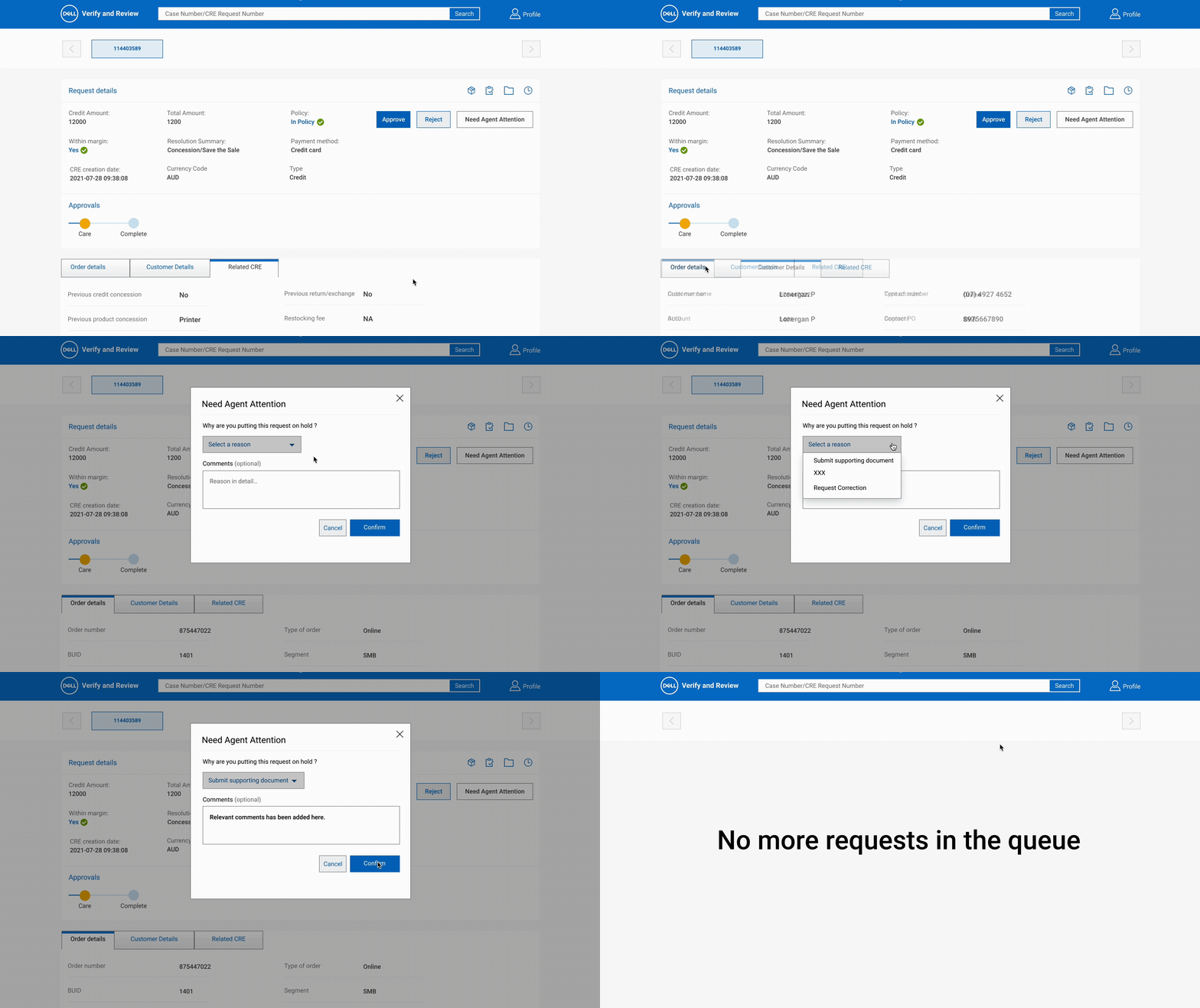
The interface was designed to give care agents clear visibility into request context—surfacing relevant policy details, request status, and next steps in one place—so they could review exceptions, make informed decisions, and progress requests with confidence and speed.
High Fidelity Prototypes
Similar working prototypes were tested with care agents to identify usability issues early, allowing us to address pain points and refine the UI before development.
Impact & Outcomes
The new Streamliner framework was first tested in the ANZ region due to its technical and regional feasibility advantages, making it the ideal choice for the initial POC. This allowed us to gather impact metrics and validate design decisions, ensuring the framework effectively addressed user pain points before broader rollout.

5x Faster
CRE Request Processing
Case Creation → CRE Request Processing → Payment Processing