
Polaris
Designing an AI-Assisted Validation Tool That Increased Processing Speed by 3.3×
As a consultant, I worked on a pilot project for Airbus to demonstrate how AI could assist in validating complex manufacturing diagrams. The goal was to explore how AI could reduce manual effort by identifying missing or inconsistent information and supporting engineers with a faster, more reliable validation workflow.
Revamping a medical product for the US market to ensure ADA compliance and drive wider adoption.
My client, who offers a Medicare product suite for the U.S. market, was facing challenges because their offerings X not ADA-compliant. As the UX Lead on this project, I led the redesign of their flagship medical product and conducted UAT with real users of assistive technologies who have visual disabilities.
Client
Airbus
Duration
4 Weeks
Industry
Aviation
Scope of Work
AI-Driven
Enterprise Saas
Design Advocacy
Project Context
Building an AI-Assisted Tool for Manufacturing Diagram Validation
Aeronautical engineers manually validated manufacturing diagrams by cross-checking them against BOMs, revisions, configurations, and other engineering data. The process was repetitive and time-consuming, requiring engineers to move across multiple sources to identify and confirm inconsistencies. The project explored how AI could reduce this manual effort while keeping engineers informed and in control of the final validation.
Project Vision


Initial Approach
The Team Planned Black-Box Automation
When I joined the project, the initial direction was straightforward: AI would detect a mismatch, suggest a resolution, and let the engineer accept or reject the result.
Why This Approach?
Fast To Build
Minimal UI and interaction logic.
Simpler AI Implementation
The initial AI functionality was relatively straightforward to implement.
Simple Decision Flow
AI Detects → AI Suggests → Engineer Accepts / Rejects
What Concerned Me?
Trust
Engineers couldn’t act on what they couldn’t verify.
Traceability
Nothing connects the AI's output back to the diagram.
No Handoff
When AI couldn't resolve an issue, the engineer had to restart the investigation from scratch.
Project Context
Building an AI-Assisted Tool for Manufacturing Diagram Validation
Aeronautical engineers manually validated manufacturing diagrams by cross-checking them against BOMs, revisions, configurations, and other engineering data. The process was repetitive and time-consuming, requiring engineers to move across multiple sources to identify and confirm inconsistencies. The project explored how AI could reduce this manual effort while keeping engineers informed and in control of the final validation.
Project Vision
Initial Approach
The Team Planned Black-Box Automation
When I joined the project, the initial direction was straightforward: AI would detect a mismatch, suggest a resolution, and let the engineer accept or reject the result.
Why This Approach?
Fast To Build
Minimal UI and interaction logic.
Simpler AI Implementation
The initial AI functionality was relatively straightforward to implement.
Simple Decision Flow
AI Detects → AI Suggests → Engineer Accepts / Rejects
What Concerned Me?
Trust
Engineers couldn’t act on what they couldn’t verify.
Traceability
Nothing connects the AI's output back to the diagram.
No Handoff
When AI couldn't resolve an issue, the engineer had to restart the investigation from scratch.
Discovery
Understanding What Engineers Need to Trust AI Output
Before changing the direction, I wanted to understand how engineers would evaluate an AI-generated result: what information they would need to verify it, what they would expect to see behind a recommendation, and what would give them enough confidence to act.
I spoke with engineers about their validation practices, the information they rely on, and the expectations they would have from an AI-assisted workflow.
Discovery
Understanding How Engineers Validate Manufacturing Diagrams
Before changing the direction, I wanted to understand how engineers would evaluate an AI-generated result: what information they would need to verify it, what they would expect to see behind a recommendation, and what would give them enough confidence to act.
I spoke with engineers about their validation practices, the information they rely on, and the expectations they would have from an AI-assisted workflow.
01
Cross-Referencing Engineering Data
“...I need to check the drawing with the BOM and master data, especially the P/N, quantity and parameters. Sometimes I have to pivot between different data sets to understand where the deviation is coming from...”
Insight- Validation requires cross-referencing multiple engineering data sources and attributes, not just matching a part number.
02
Making Validation Traceable
“...when there is a missing or validation deviation in the Post-BOM, I want to know what was compared, which validation rules were applied...”
Insight- Engineers need a traceable validation trail showing what was checked, which rules were applied, and where human review is still required.
03
Establishing Document Relationships
“...for one part there can be the drawing, BOM and other technical data. I need to check the revision, configuration and document mapping before I know which information is valid for the component...”
Insight- Engineers need relationships between drawings, BOMs and technical documents to determine which data should be trusted.
04
Tracing the Source of AI Recommendations
“...if the AI suggests a different material, supplier or P/N, I need to see where it got the information from. I cannot just accept the suggestion if I can’t confirm the source data...”
Insight- AI recommendations need source-level evidence so engineers can assess and trust the suggested value.
01
Cross-Referencing Engineering Data
“...I need to check the drawing with the BOM and master data, especially the P/N, quantity and parameters. Sometimes I have to pivot between different data sets to understand where the deviation is coming from...”
Insight- Validation requires cross-referencing multiple engineering data sources and attributes, not just matching a part number.
02
Making Validation Traceable
“...when there is a missing or validation deviation in the Post-BOM, I want to know what was compared, which validation rules were applied...”
Insight- Engineers need a traceable validation trail showing what was checked, which rules were applied, and where human review is still required.
03
Establishing Document Relationships
“...for one part there can be the drawing, BOM and other technical data. I need to check the revision, configuration and document mapping before I know which information is valid for the component...”
Insight- Engineers need relationships between drawings, BOMs and technical documents to determine which data should be trusted.
04
Tracing the Source of AI Recommendations
“...if the AI suggests a different material, supplier or P/N, I need to see where it got the information from. I cannot just accept the suggestion if I can’t confirm the source data...”
Insight- AI recommendations need source-level evidence so engineers can assess and trust the suggested value.
Analysis
What Engineers Need Before They Can Act
The conversations revealed three recurring needs. Engineers needed to compare an AI finding against relevant engineering data, understand how the result was reached, and trace important information back to its source.
Together, these needs pointed to one core requirement: Engineers need to verify what the AI has done before they can confidently act on its output.

Data Comparison
Compare AI findings against the diagram, BOM, and engineering data.
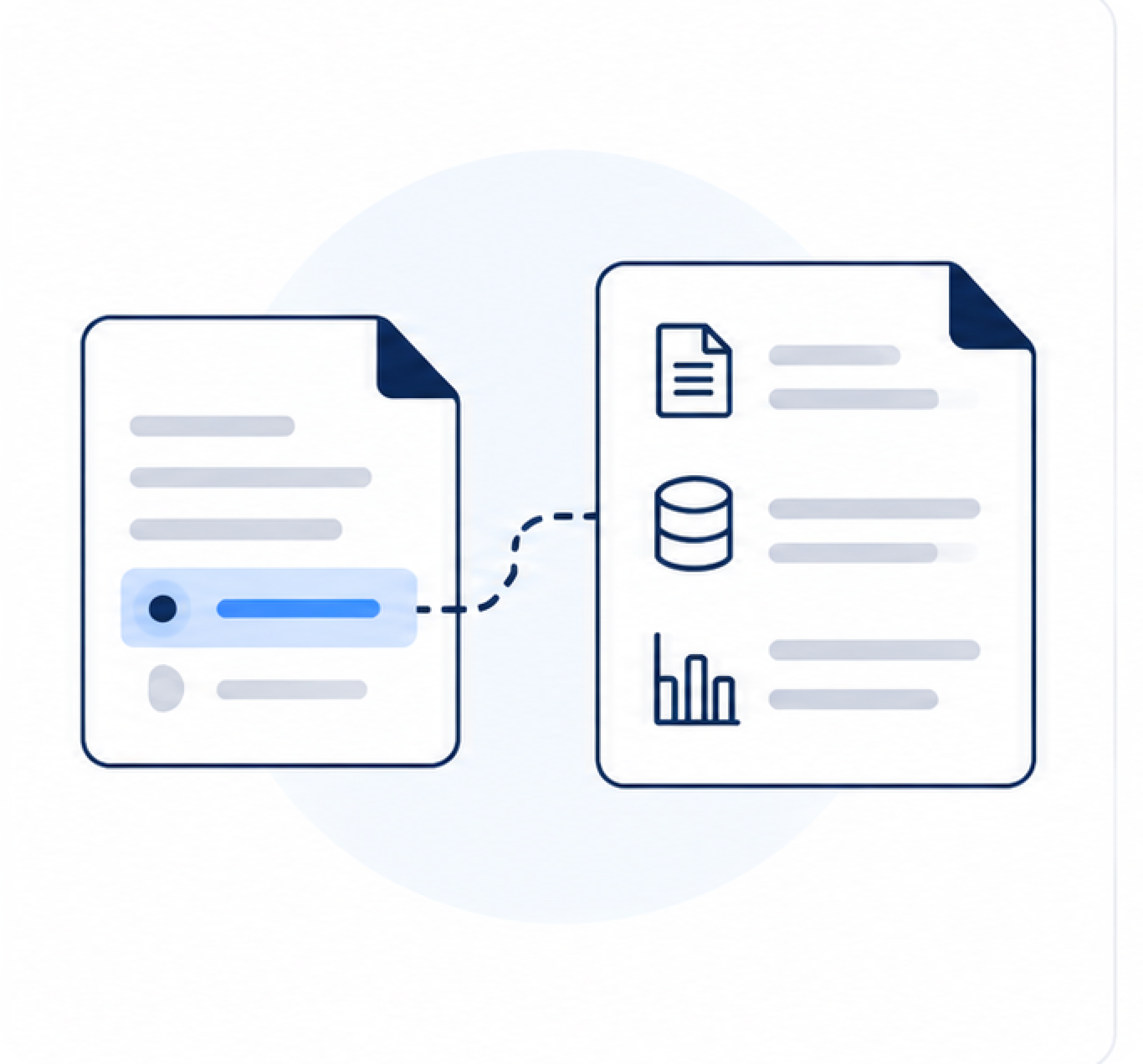
Source Traceability
Trace findings back to the documents and sources behind them.

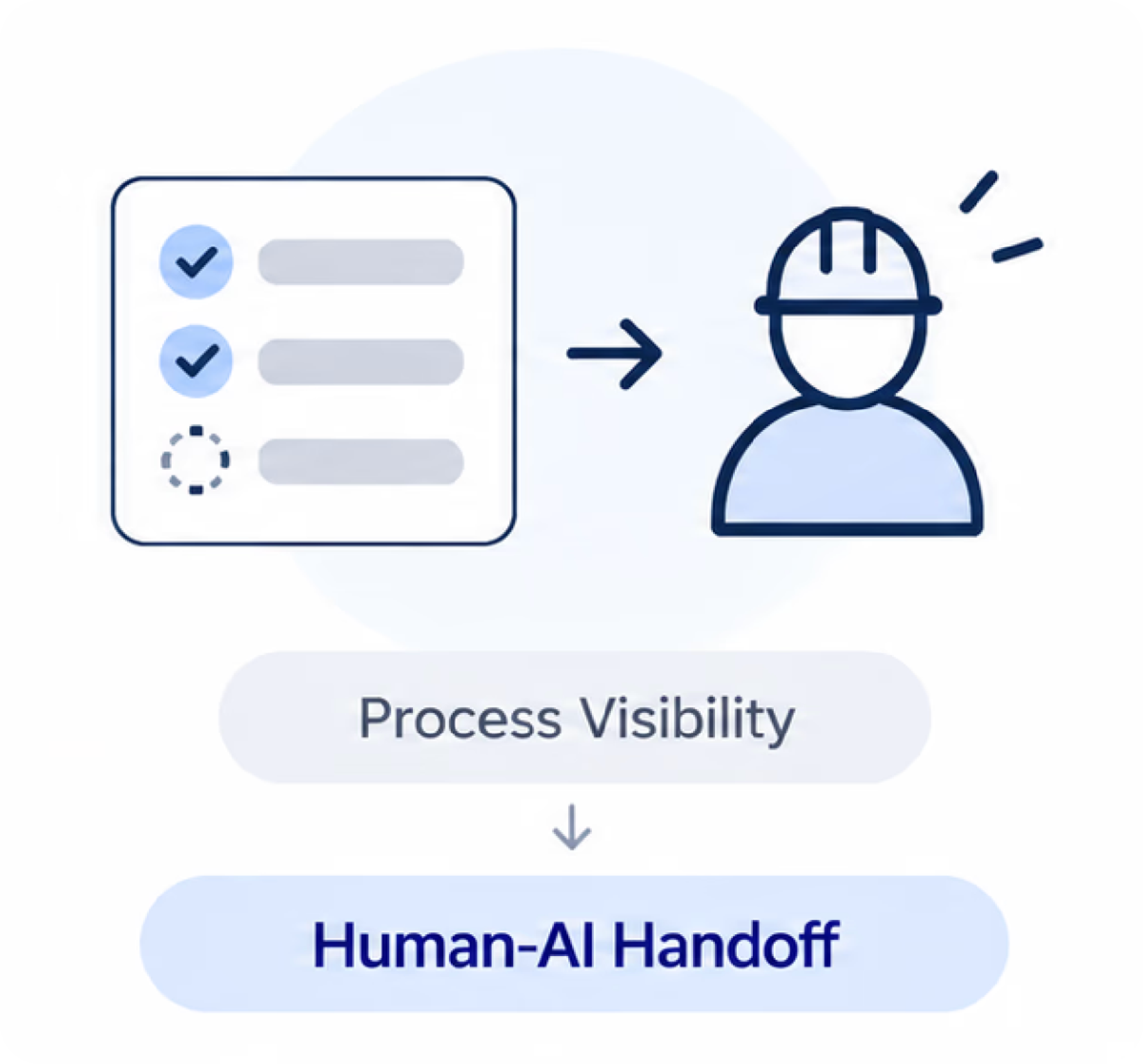
Process Visibility
See what AI checked, how it reached the result, and where it stopped.
Concept Development
From User Needs to Design Concepts
I translated the three needs identified in research into lightweight concepts, showing the team how each could be addressed in the experience. These concepts created a concrete basis for discussion and helped align the team on the product direction before moving into the detailed workflow.


Design Concepts
Exploring The Three Design Concepts
I then explored each concept in detail, using side-by-side comparisons to show the difference between the initial output-first approach and the experience engineers would need to confidently use the AI.
01 · Contextual Feedback: Connecting the Data to the Diagram
Make AI findings easier to understand and verify by connecting each result to the relevant part of the manufacturing diagram. This gives engineers the context to see exactly what the AI is referring to and compare the finding against the underlying engineering data.

02 · AI Transparency: Making AI Decisions Traceable
Give engineers visibility into how the AI arrived at a result by showing the checks performed, information considered, and sources consulted. This allows them to understand the basis of a recommendation rather than having to trust the output at face value.

03 · Human AI Handoff: Giving Engineers a Clear Handoff
When AI cannot resolve an issue, carry its investigation forward instead of handing back a blank state. Show what was checked, which files and sources were reviewed, and what steps were already taken so engineers can understand the situation and continue with a different approach.

Interaction Workflow
Mapping How Engineers and AI Work Together
With the three concepts aligned, I mapped the interaction between AI and engineers across the validation flow. The workflow defined where AI could assist, where engineers needed to verify or intervene, and how control could return to the engineer when AI could not complete the task.
Key Use Cases Covered
Missing Information- AI cannot find the required value and searches supporting sources.
AI-Suggested Value- AI proposes a value with supporting evidence for engineer review.
Manual Override- The engineer disagrees with the AI recommendation and takes control.
Review Before Submission-The engineer reopens a resolved item and updates the current value or source.

Wireframe to High Fidelity
Turning the Workflow Into a Clear Product Experience
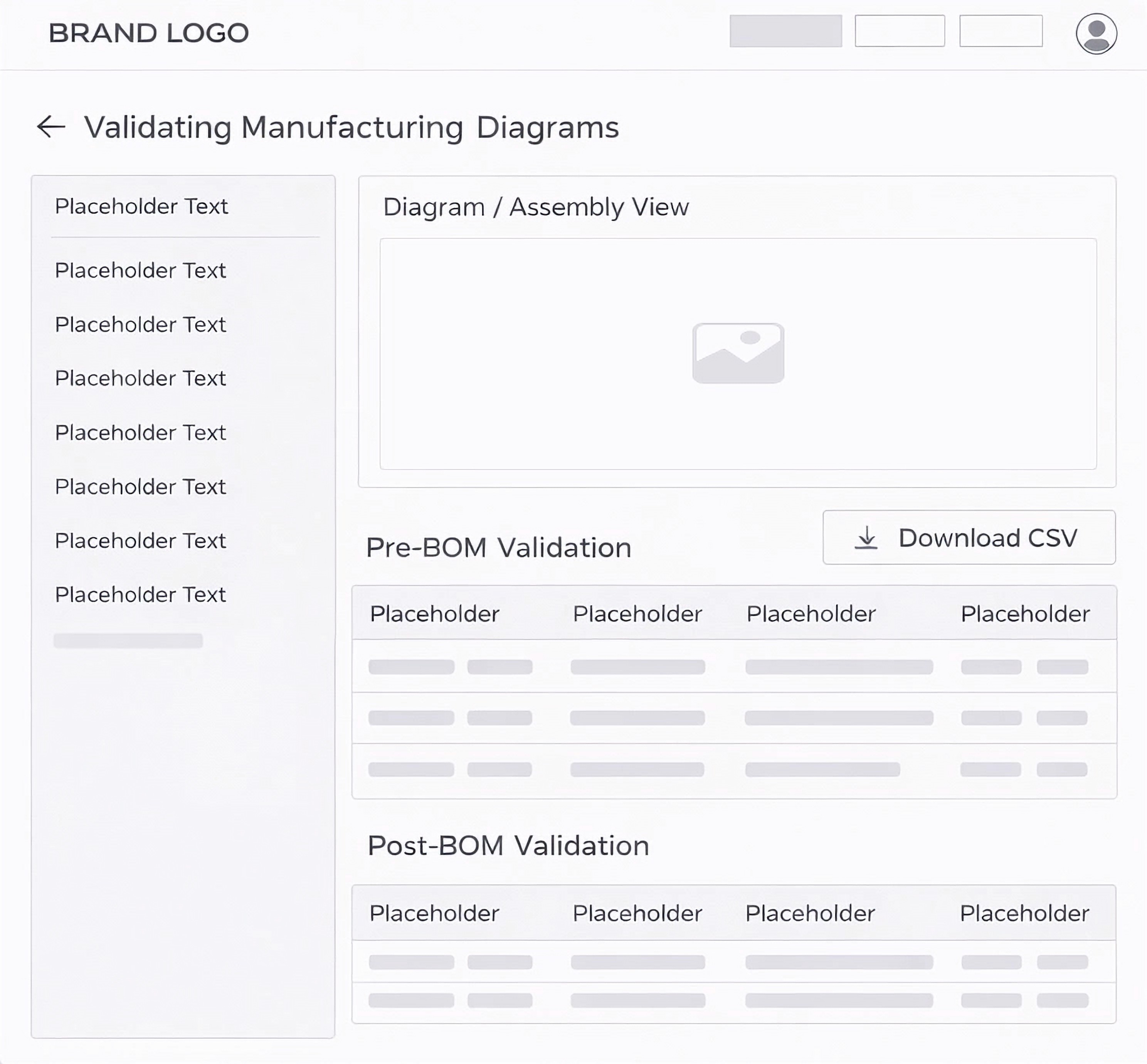
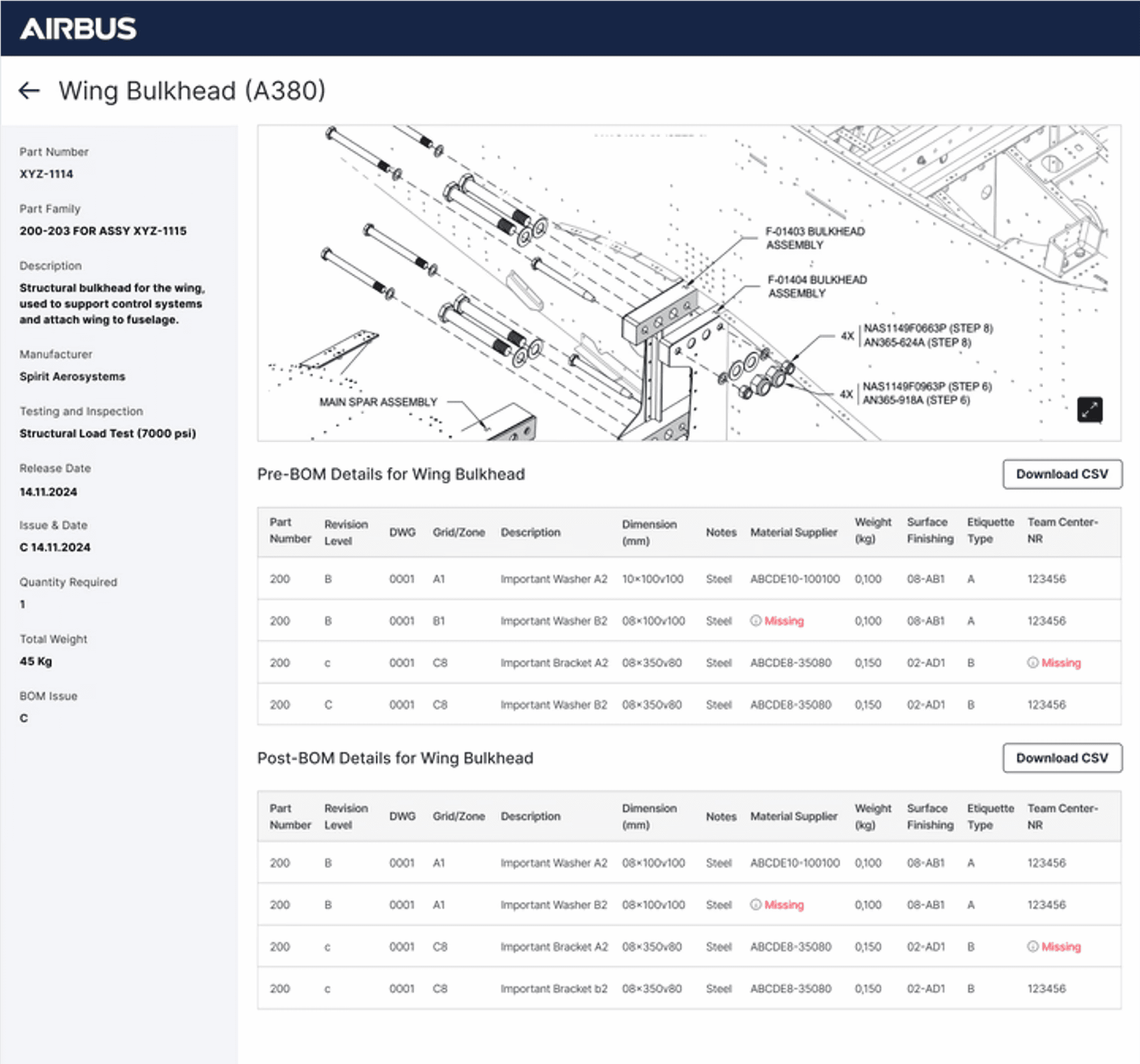
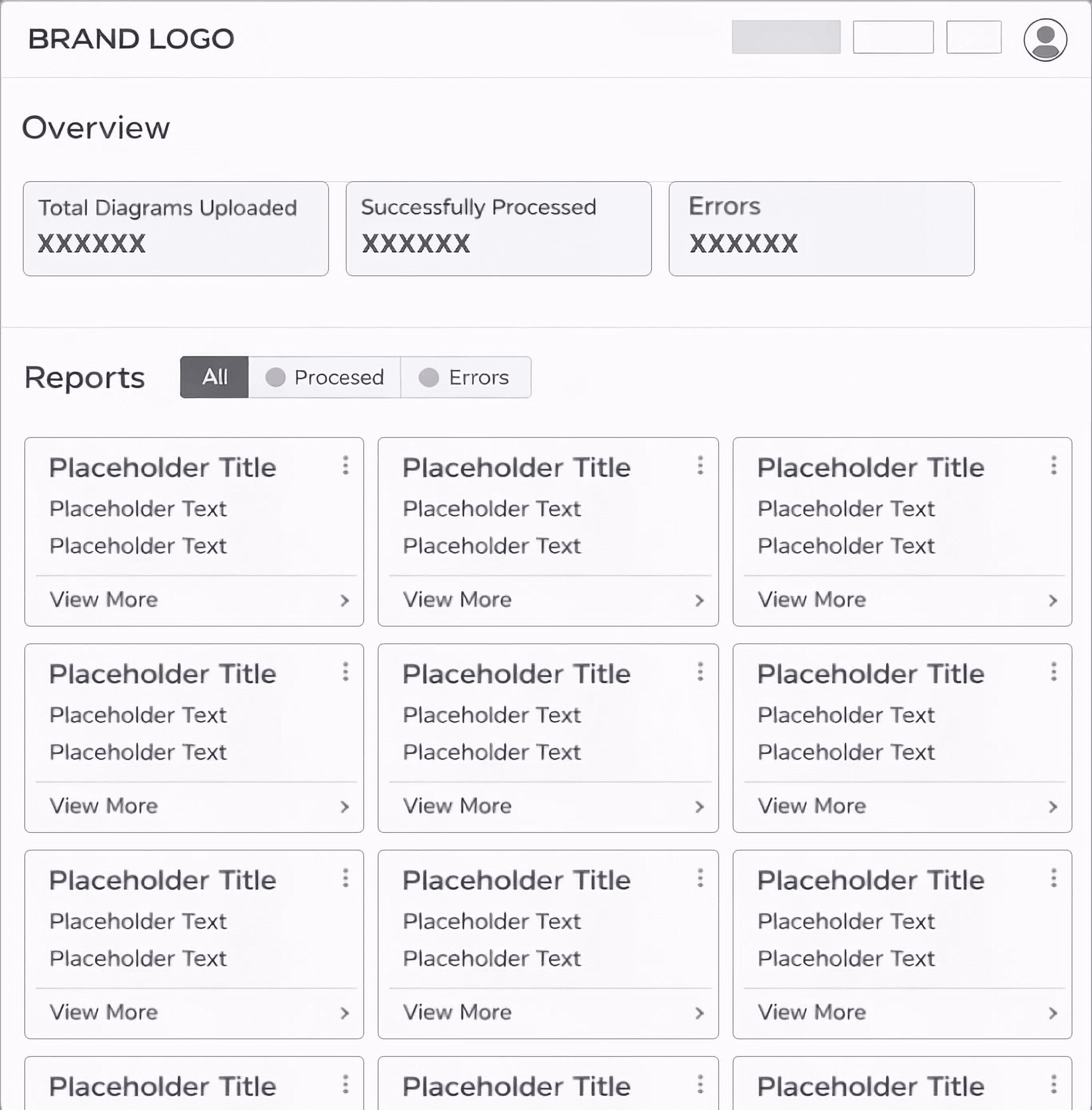
For this project, we began by creating quick wireframes to ensure alignment and shared understanding across the team. Once aligned, we developed high-fidelity Figma prototypes, all while keeping in mind the constraints of FlutterFlow, the no-code platform we used to deliver the final product. This ensured the design was both realistic and achievable from concept to final build.

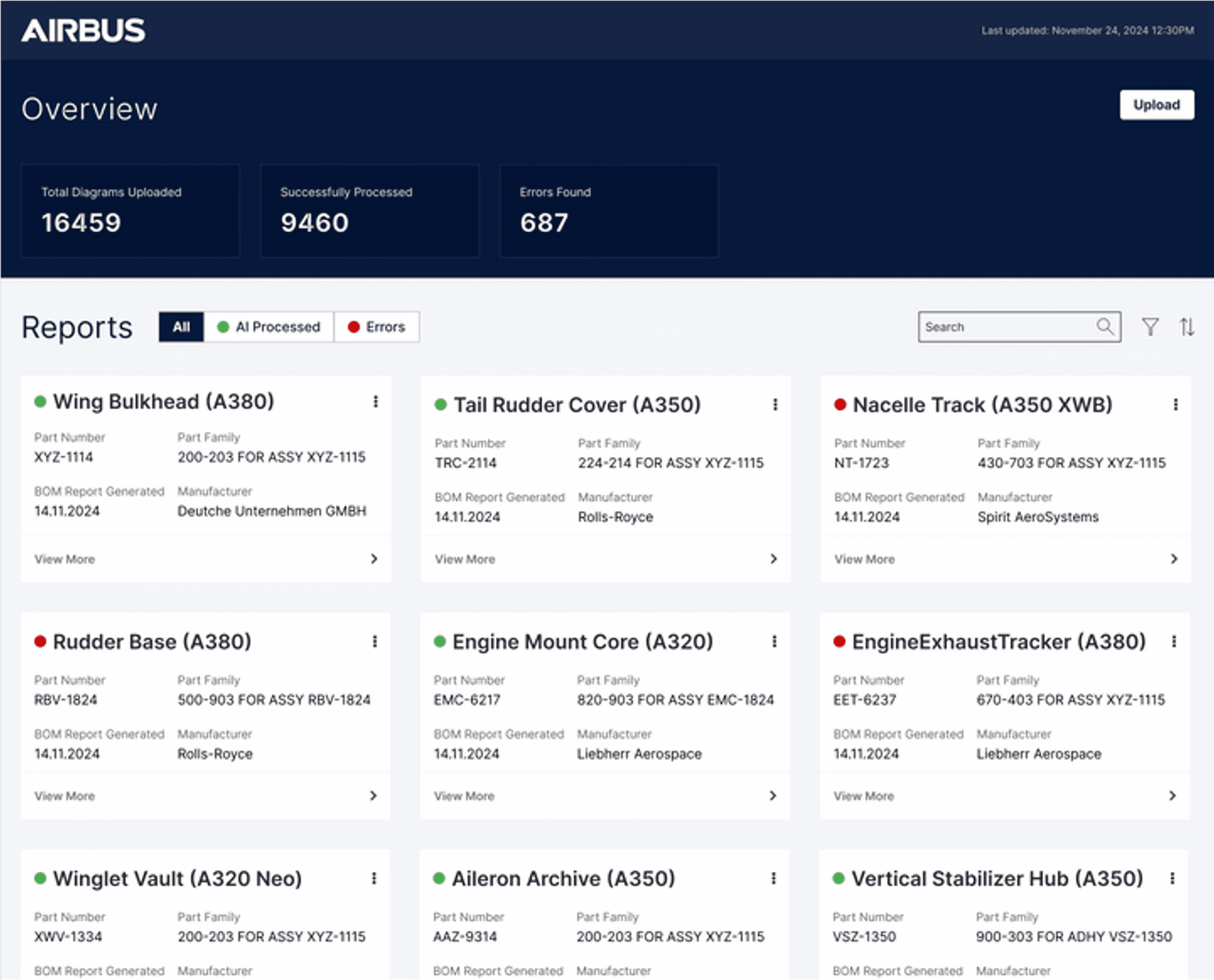

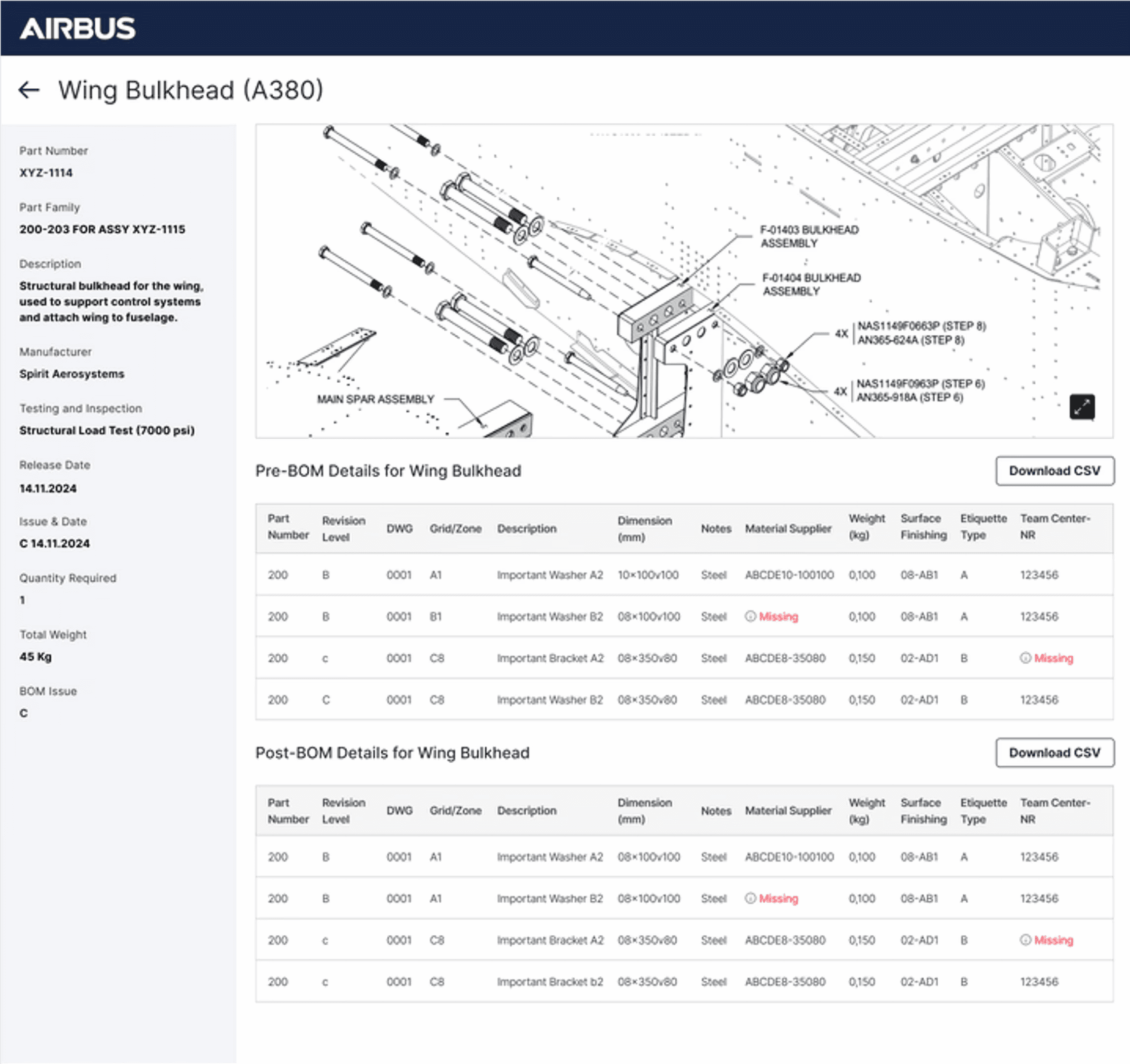
Turning the Workflow Into a Clear Product Experience
For this project, we began by creating quick wireframes to ensure alignment and shared understanding across the team. Once aligned, we developed high-fidelity Figma prototypes, all while keeping in mind the constraints of FlutterFlow, the no-code platform we used to deliver the final product. This ensured the design was both realistic and achievable from concept to final build.
Wireframe to High Fidelity
Prototype
Promt to Code
The product was originally built in FlutterFlow. For the portfolio, I recreated the experience as a working prototype using Claude, translating the key interactions and workflow into a functional product that could be experienced beyond static screens.
Prompt to Code
For the project, we originally built it in FlutterFlow, but for the purpose of showcasing it in my portfolio, I created a working prototype using Claude.
Prototype
Business Impact
3.3x Faster Diagram Validation
By shifting repetitive comparison work from manual checks to an AI-assisted workflow, engineers could spend less time searching and reconciling information and more time reviewing the results that require their expertise.
Learnings
Considerations for Building AI-Assisted Products
This project changed how I think about designing AI-assisted workflows. The biggest shift was moving from designing for what AI can automate to designing for what people need to understand, verify, and control.
01 · Source Builds Trust
AI output alone wasn’t enough. Engineers needed to see where the result came from before they could trust it.
02 · Back Design Opinions With Evidence
Without research and a principle to stand on, a design direction reads as intuition, and intuition loses to a faster build every time. With evidence, it stops being my preference and becomes the project's problem to solve.
03 · Failure States Matter as Much as Success States
With AI products, users judge the system by what it does when it can't answer. That state deserves the same attention as the one where everything works.
Explore Other Client Projects


Reimagining Applications with AI
PitchHub
Google's sales enablement team creates hundreds of MVPs each quarter, demonstrating how Vertex AI integrates with diverse applications. As consultants, we ran a pilot project to prove we could take over this process, delivering scalable MVP development for Google.
Client
Google (Vertex AI – Sales Enablement Team)
Duration
2 weeks
Industry
AI & Cloud Computing
Scope of work
SaaS
AI-Driven
No-code
Project Context
Building an AI-Assisted Tool for Manufacturing Diagram Validation
Aeronautical engineers manually validated manufacturing diagrams by cross-checking them against BOMs, revisions, configurations, and other engineering data. The process was repetitive and time-consuming, requiring engineers to move across multiple sources to identify and confirm inconsistencies. The project explored how AI could reduce this manual effort while keeping engineers informed and in control of the final validation.
Project Vision
The Team Planned Black-Box Automation
I spoke with engineers involved in diagram validation to understand how they review drawings, compare them against BOM and engineering data, and investigate discrepancies across supporting documentation.
Initial Approach
Why This Approach?
Fast To Build
Minimal UI and interaction logic.
Simpler AI Implementation
The initial AI functionality was relatively straightforward to implement.
Simple Decision Flow
AI Detects → AI Suggests → Engineer Accepts / Rejects
What Concerned Me?
Trust
Engineers couldn’t act on what they couldn’t verify.
Traceability
Nothing connects the AI's output back to the diagram.
No Handoff
When AI couldn't resolve an issue, the engineer had to restart the investigation from scratch.
Analysis
Three Core Requirements for the Solution.
The analysis distilled the recurring needs across the validation process into three essential pillars for the solution.
Data Comparison
Compare AI findings against the diagram, BOM, and engineering data.
Process Visibility
See what AI checked, how it reached the result, and where it stopped.
Process Visibility
See what AI checked, how it reached the result, and where it stopped.
Concept Development
From User Needs to Design Concepts
I translated the three needs identified in research into lightweight concepts, showing the team how each could be addressed in the experience. These concepts created a concrete basis for discussion and helped align the team on the product direction before moving into the detailed workflow.
Design Concepts
Exploring The Three Design Concepts
I then explored each concept in detail, using side-by-side comparisons to show the difference between the initial output-first approach and the experience engineers would need to confidently use the AI.
Interaction Workflow
Mapping How Engineers and AI Work Together
With the three concepts aligned, I mapped the interaction between AI and engineers across the validation flow. The workflow defined where AI could assist, where engineers needed to verify or intervene, and how control could return to the engineer when AI could not complete the task.
Key Use Cases Covered
Missing Information- AI cannot find the required value and searches supporting sources.
AI-Suggested Value- AI proposes a value with supporting evidence for engineer review.
Manual Override- The engineer disagrees with the AI recommendation and takes control.
Review Before Submission-The engineer reopens a resolved item and updates the current value or source.
Wireframe to High Fidelity
Turning the Workflow Into a Clear Product Experience
For this project, we began by creating quick wireframes to ensure alignment and shared understanding across the team. Once aligned, we developed high-fidelity Figma prototypes, all while keeping in mind the constraints of FlutterFlow, the no-code platform we used to deliver the final product. This ensured the design was both realistic and achievable from concept to final build.
Prototype
Prompt to Code
The product was originally built in FlutterFlow. For the portfolio, I recreated the experience as a working prototype using Claude, translating the key interactions and workflow into a functional product that could be experienced beyond static screens.
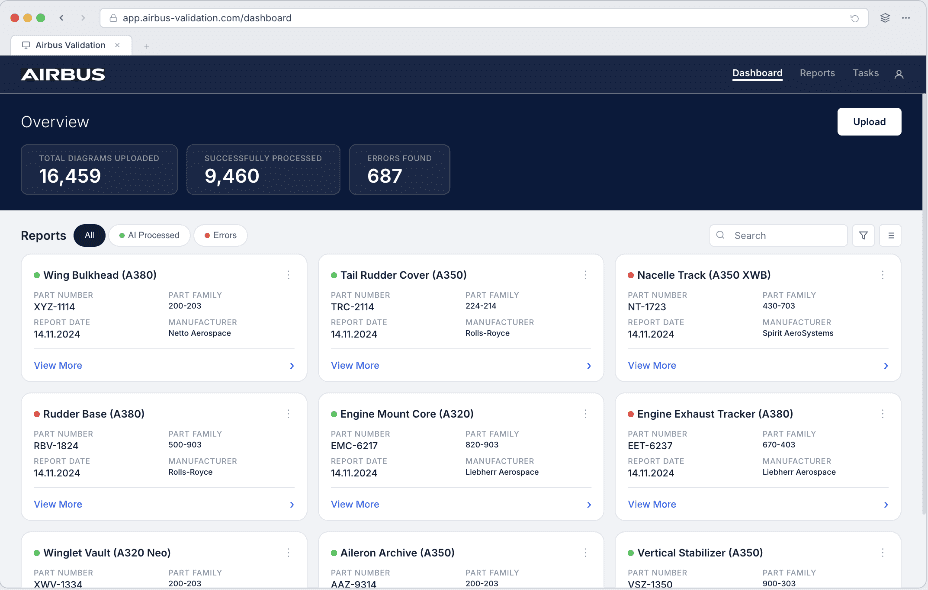
Through stakeholder interviews and user feedback, I found that trust was the key adoption barrier. Engineers valued AI assistance, but only when they could understand its recommendations, validate its reasoning, and remain accountable for every decision.
Understanding How Engineers Validate Manufacturing Diagrams
Discovery
Cross-Referencing Engineering Data
(01)
“...I need to check the drawing with the BOM and master data, especially the P/N, quantity and parameters. Sometimes I have to pivot between different data sets to understand where the deviation is coming from...”
-Design Engineer
Insight- Validation requires cross-referencing multiple engineering data sources and attributes, not just matching a part number.
Making Validation Traceable
(02)
“...when there is a missing or validation deviation in the Post-BOM, I want to know what was compared, which validation rules were applied...”
-Design Engineer
Insight- Engineers need a traceable validation trail showing what was checked, which rules were applied, and where human review is still required.
Establishing Document Relationships
(03)
“...for one part there can be the drawing, BOM and other technical data. I need to check the revision, configuration and document mapping before I know which information is valid for the component...”
-Design Engineer
Insight- Engineers need relationships between drawings, BOMs and technical documents to determine which data should be trusted.
Tracing the Source of AI Recommendations
(04)
“...if the AI suggests a different material, supplier or P/N, I need to see where it got the information from. I cannot just accept the suggestion if I can’t confirm the source data...”
-Design Engineer
Insight- AI recommendations need source-level evidence so engineers can assess and trust the suggested value.
Measurable Impact
3.3X Faster
Faster turnaround validating complex manufacturing diagrams against the bill of materials — compared to the fully manual workflow.
01 · Contextual Feedback: Connecting the Data to the Diagram
Make AI findings easier to understand and verify by connecting each result to the relevant part of the manufacturing diagram. This gives engineers the context to see exactly what the AI is referring to and compare the finding against the underlying engineering data.
Concept Development
From User Needs to Design Concepts
I translated the three needs identified in research into lightweight concepts, showing the team how each could be addressed in the experience. These concepts created a concrete basis for discussion and helped align the team on the product direction before moving into the detailed workflow.
Design Concepts
Exploring The Three Design Concepts
I then explored each concept in detail, using side-by-side comparisons to show the difference between the initial output-first approach and the experience engineers would need to confidently use the AI.
02 · AI Transparency: Making AI Decisions Traceable
Give engineers visibility into how the AI arrived at a result by showing the checks performed, information considered, and sources consulted. This allows them to understand the basis of a recommendation rather than having to trust the output at face value.

03 · Human AI Handoff: Giving Engineers a Clear Handoff
When AI cannot resolve an issue, carry its investigation forward instead of handing back a blank state. Show what was checked, which files and sources were reviewed, and what steps were already taken so engineers can understand the situation and continue with a different approach.

Analysis
Three Core Requirements for the Solution.
The analysis distilled the recurring needs across the validation process into three essential pillars for the solution.
Data Comparison
Compare AI findings against the diagram, BOM, and engineering data.
Data Comparison
Compare AI findings against the diagram, BOM, and engineering data.
Process Visibility
See what AI checked, how it reached the result, and where it stopped.
Process Visibility
See what AI checked, how it reached the result, and where it stopped.
Process Visibility
See what AI checked, how it reached the result, and where it stopped.
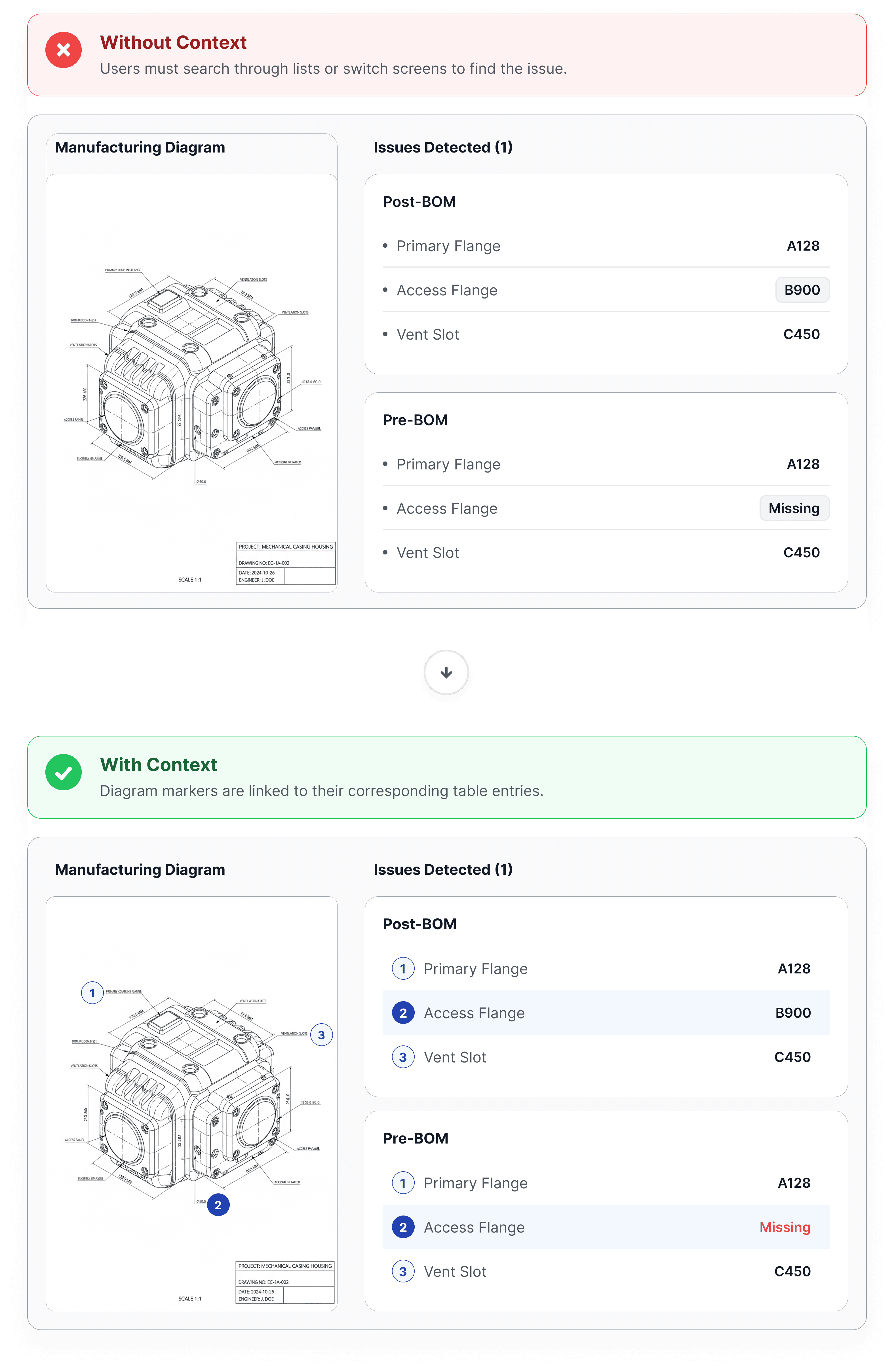
01 · Contextual Feedback: Connecting the Data to the Diagram
Make AI findings easier to understand and verify by connecting each result to the relevant part of the manufacturing diagram. This gives engineers the context to see exactly what the AI is referring to and compare the finding against the underlying engineering data.
02 · AI Transparency: Making AI Decisions Traceable
Give engineers visibility into how the AI arrived at a result by showing the checks performed, information considered, and sources consulted. This allows them to understand the basis of a recommendation rather than having to trust the output at face value.

03 · Human AI Handoff: Giving Engineers a Clear Handoff
When AI cannot resolve an issue, carry its investigation forward instead of handing back a blank state. Show what was checked, which files and sources were reviewed, and what steps were already taken so engineers can understand the situation and continue with a different approach.
